How Long Does a Full Set of Acrylics Take? A Realistic Breakdown
By Laz · October 23, 2026
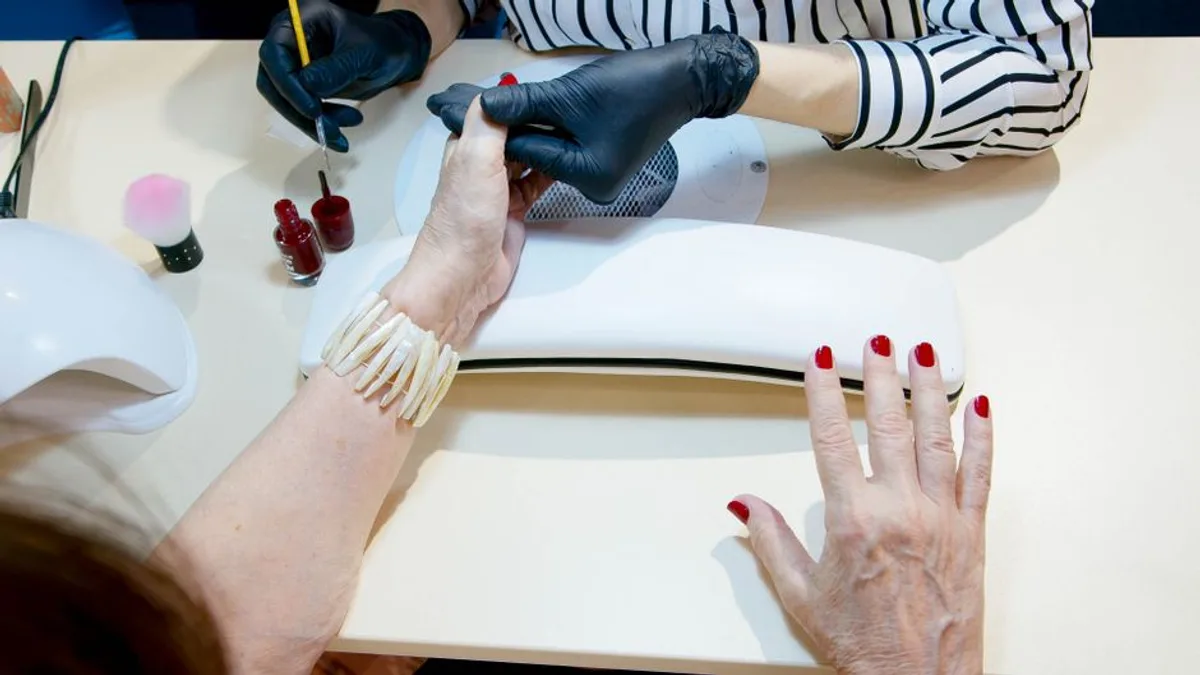
Photo by Artem Podrez on Pexels
Book 1.5 to 2 hours for a standard salon full set. That's the number to put in your calendar, and it covers the whole appointment: prep, tips or forms, acrylic application, shaping, and a one-color polish or gel finish. Not just the time your hands spend laying down product.
If you've been guessing at 60 minutes and running behind all day, that's the fix. If you're a client who keeps getting squeezed into a slot that was never big enough, this is why.
Here's the full breakdown: what the 90 minutes actually contains, what stretches it, and how to keep a long block from getting chopped up by short bookings.
The Short Answer: 1.5 to 2 Hours for Most Full Sets
A standard full set runs 1.5 to 2 hours in a salon. That's the working default for most technicians, and it holds up across most clients.
You'll see a basic set quoted at 45 to 90 minutes. That range is real, but it comes with conditions attached. The shorter estimate generally assumes three things:
- An experienced technician who's done the service hundreds of times.
- Uncomplicated length and shape, nothing extreme.
- No removal of existing enhancements.
Take away any one of those and the clock moves. Take away two and you're past two hours before you've picked up a file.
So use 1.5 to 2 hours as your scheduling floor, then adjust up or down based on the client in front of you. A new client with old product on her nails is not a 45-minute appointment. She never was.
The mistake I see most often is booking the application time and forgetting everything around it. The product goes on in maybe 30 to 45 minutes. The rest is prep, shaping, and finish, and none of that is optional.
What Actually Happens in Those 90 Minutes
Break the appointment into its real parts and the 1.5 to 2 hour block stops looking generous.
Prep. This starts before any product touches the nail. Sanitizing tools and hands, prepping the nail plate, cuticle work, and surface filing so the acrylic has something to grip. Skip the filing and the set lifts in a week. This step alone can eat 15 to 20 minutes on a client with dry cuticles or damaged nails.
Application. Attaching tips or forms, then building the acrylic structure layer by layer. This is the part everyone pictures when they hear "full set," and it's genuinely the bulk of the hands-on work. But it can't start until prep is done, and it can't be rushed without the structure suffering.
Shaping and finishing. Filing down to the final shape, buffing the surface smooth, and applying a one-color polish or gel finish. Shaping is where a set goes from "done" to "good," and it takes real time. Ten to twenty minutes depending on length and how fussy the client is about the shape.
Add it up. Prep, application, shape, finish. That's your 90 minutes, and often closer to 120 once you factor in the small stuff: the client who wants to chat, the bottle that needs refilling, the tip that goes on crooked and has to come off.
Each step has its own clock. The total is always more than the sum of the product application.
If you're building out your scheduling around services like this, salon scheduling software: the real workflow behind booking walks through how the pieces fit together.
The Variables That Stretch Your Appointment
The 1.5 to 2 hour range is a starting point, not a rule. Several things push it longer, and they're predictable if you ask about them up front.
Removal of old product
Removing old acrylics or gel adds roughly 15 to 30 minutes. That's soak time, careful filing, and cleanup, and it can't be skipped or shortened without risking damage to the natural nail.
Clients should say they need a removal when they book, not assume it's folded into the standard slot. A tech who planned for a fresh set and finds a full set of old acrylic on arrival is now 20 minutes behind for the rest of the day. That's how a whole afternoon goes sideways.
Art, length, and shape
Intricate nail art, extreme length, or shapes like stiletto can add 20 to 60 minutes or more. Detailed work pushes the appointment into 2 to 3 hour territory, and that's realistic, not padded.
Stiletto and coffin shapes take longer to file and longer to get symmetrical. Chrome, ombre, hand-painted designs, rhinestones, all of it adds time. A client who wants a full set plus art is not booking the same appointment as a client who wants a plain set.
Sculpted sets
Sculpted acrylic sets commonly take 90 to 120 minutes. That's longer than many tip-based applications because the technician builds the extension directly on forms, one nail at a time, controlling the shape from the start.
Sculpting is a skill, and it's slower than gluing a tip and building over it. If a client requests sculpted, book the longer slot. Don't try to fit it into a standard full set window and hope.
None of these add-ons live inside the standard 1.5 to 2 hour slot. Plan for them separately, quote them separately, and book them separately. If you want a framework for pricing these variations, salon pricing: what to charge in 2026 without guessing covers it.
Here's a quick reference for how the timing shifts:
| Scenario | Typical time |
|---|---|
| Basic set, experienced tech, no removal, simple shape | 45 to 90 minutes |
| Standard full set, prep through finish | 1.5 to 2 hours |
| Full set plus removal of old product | Add 15 to 30 minutes |
| Full set plus intricate art or extreme length | Add 20 to 60 minutes or more |
| Sculpted acrylic set | 90 to 120 minutes |
| Detailed art on a full set | 2 to 3 hours |
Print that. Tape it inside a cabinet. It's the honest version.
When You're the One Holding the Brush: DIY Timing
If you're doing your own set at home, throw the salon numbers out the window. The timing is dramatically longer, and the gap surprises people.
Beginners may need approximately 8 to 12 hours for both hands. That's not a typo. Eight to twelve hours, spread across a day or two, for a full set done on yourself.
More experienced DIY users can cut that down to about 4 to 6 hours. Still a full afternoon, still a lot longer than a salon appointment, but manageable.
The gap comes from three things. The learning curve, because you're figuring out ratio and structure as you go. Drying time, because you can't work at salon speed with one hand. And the simple fact that you're doing both hands yourself, which means every step takes roughly twice as long as it would if someone else were working on you.
If you're doing your own set, block out a full day. Or split it across two: one hand today, one hand tomorrow. Trying to squeeze a DIY full set into a two-hour window is how people end up with one hand done and a ruined evening.
The same logic applies to anyone learning the service. The 45-minute basic set belongs to a tech who's done it a thousand times. Nobody starts there.
Booking Smarter: How to Protect Your Calendar
A full set is a high-value block. Two hours of your day, one client, real money. The problem is what happens when your booking system lets short services slice into it.
Say you've got a 2-hour full set on the calendar for Saturday at 1pm. A client goes to book online and sees a 30-minute gap at 1:30 because the system reads your calendar minute by minute and doesn't understand the block is one unit. She books a quick service. Now your full set is split, and you're either turning someone away or working around a booking that never should have been offered.
That's calendar fragmentation, and it's the thing we built Chairwarden to stop. Short bookings can never split a long, high-value block, so clients booking online never see a slot that would break it apart.
Setup takes about two minutes. You tell Chairwarden how long a quick service takes and how long a long one takes. That's it. The app handles the rest.
Two modes, one goal
Chairwarden gives you two ways to run protection:
- Strict mode never allows fragmentation. A short service can't land inside or across a long block, period.
- Relaxed mode allows a short service at the edges of a block when it wouldn't meaningfully fragment it. You get a little more fill without giving up the block.
Most stylists start on strict and loosen up once they see how it behaves. Both modes do the same core job: they keep your 2-hour full set from turning into two 45-minute scraps with a hole in the middle.
This matters more the more you rely on online booking. The whole point of a booking page is that clients fill your calendar without you babysitting it. If the page offers slots you'd never approve, you're back to checking it by hand. If you want to go deeper on that, how to use protected calendar blocks as a stylist (without losing clients) covers the tactics.
What you get on each tier
- Free tier: no credit card, up to 15 bookings a month, calendar protection included from the first booking.
- Individual plan: $29/mo, or $23/mo billed annually. Unlimited bookings, 500 SMS reminders a month included.
Both tiers include a public booking page on your own link, Google Calendar two-way sync, and email reminders. SMS comes with Individual.
There's an import wizard that brings your client list over from Vagaro, Square, GlossGenius, or Schedulicity, with a preview before anything moves. No percentage cut on card payments, no hidden fees.
If you're still weighing software generally, salon booking software: what it costs, what it does, and what to skip is a good place to start. And if the Swiss cheese calendar is already costing you money, the Swiss cheese calendar problem: why booth renters are losing $1,000 a month gets into the math.
The Bottom Line on Timing
Book 1.5 to 2 hours for a standard full set. Add 15 to 30 minutes for removal. Add 20 to 60 minutes for art or extreme shapes. Book 90 to 120 minutes for sculpted. And if you're doing it yourself, clear your day.
The number isn't the hard part. Protecting the block once it's on your calendar is. A full set that gets fragmented by a short booking costs you the same as a cancellation, and it's a lot more annoying because the client is standing in front of you.
Chairwarden exists for exactly that. Two-minute setup, calendar protection from the first booking, free tier with no credit card. If you want to see whether it fits how you work, start on the free plan and book a full set through your own page. Watch what the calendar does. That'll tell you more than any sales page.
The $1,083/mo figure referenced in the Swiss cheese calendar post is a calculation based on stated assumptions, not a promise of revenue.
Frequently Asked Questions
How long does a full set of acrylics take for a beginner?
A beginner doing their own acrylics at home may need 8–12 hours for both hands, compared to 4–6 hours for more experienced DIY users. In a salon, a basic set can take 45–90 minutes, but that assumes an experienced technician and no removal.
Does removal add time to a full set appointment?
Yes. Removing old acrylics or gel adds roughly 15–30 minutes. Always tell your technician when booking so they can schedule enough time.
How long does nail art add to a full set?
Intricate nail art, extreme length, or shapes like stiletto can add 20–60 minutes or more. For detailed work, a 2–3-hour appointment is realistic.
Are sculpted acrylics faster or slower than tip-based sets?
Sculpted acrylic sets commonly take 90–120 minutes, which is longer than many tip-based applications because the technician builds the extension directly on forms.
On Chairwarden
Nail salon software
A full set and a fill are not the same appointment, and the calendar should know.
Read the full pageFree tools
- Calendar fragmentation calculator
Put in your own service prices and durations, and see what a short booking landing in the middle of an open window puts at risk.